The chain still needs to be managed.
I did not set out to develop a human–AI working method. I was building a startup and trying to manage a complex project with several specialised AI agents.
Each AI agent could produce useful work. But activity was not the same as readiness.
An agent could confidently report success while working from stale context. A component could pass a test while a lower-level dependency remained unverified. Two specialists could describe different realities because they had observed the system at different moments.
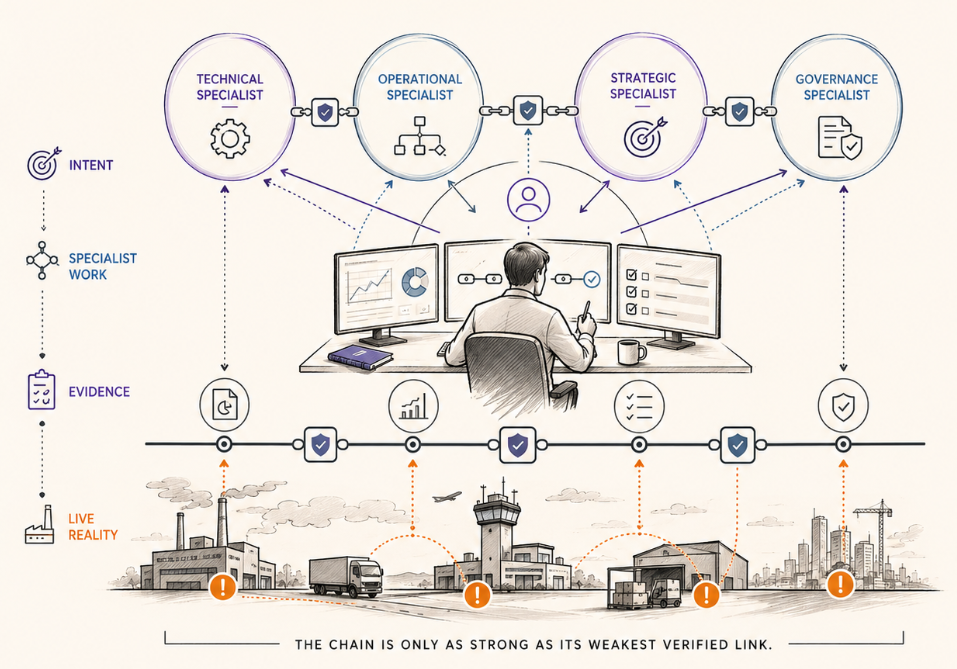
The real challenge was not simply using AI. It was managing the complete chain between human intent, specialised reasoning, technical evidence and the actual live situation.
From AI assistance to chain management
That experience led me to develop Cognitive Chain Management, or CCM: a working method for deciding whether a human–AI system is actually ready rather than merely active.
CCM treats the human as the Chain Manager, not as a passive approver. The Chain Manager defines intent, delegates within clear boundaries, translates between specialist domains, compares reported reality with live reality and retains final accountability.
- Intent before execution: specialists receive the objective, purpose, constraints and decision boundaries.
- Evidence before readiness: a confident report or successful task is not enough; the relevant evidence gate must be closed.
- Scope before system claims: a ready component does not automatically make the complete system ready.
- Reality before narrative: reported state must be checked against the live operational situation.
A combination of established practices
CCM does not claim that its underlying ideas are new. It combines established practices such as readiness levels, intent-led delegation, specialist depth, blameless learning and authoritative operational state into one repeatable human–AI operating method.
Its proposed contribution is the combination: continuous human chain management, translation between specialist domains, comparison of live and perceived reality, and one authoritative state for the complete operation.
A group of capable agents does not automatically become a reliable system.
The chain still needs to be managed.
How is your organisation deciding whether its human–AI workflow is actually ready, rather than merely active?